
Combining a Home Office and Music Corner
You do not need a separate room for work and music. With careful zoning, smart cable management and equipment that serves more than one purpose, a small room can become both a productive office and a comfortable creative space.
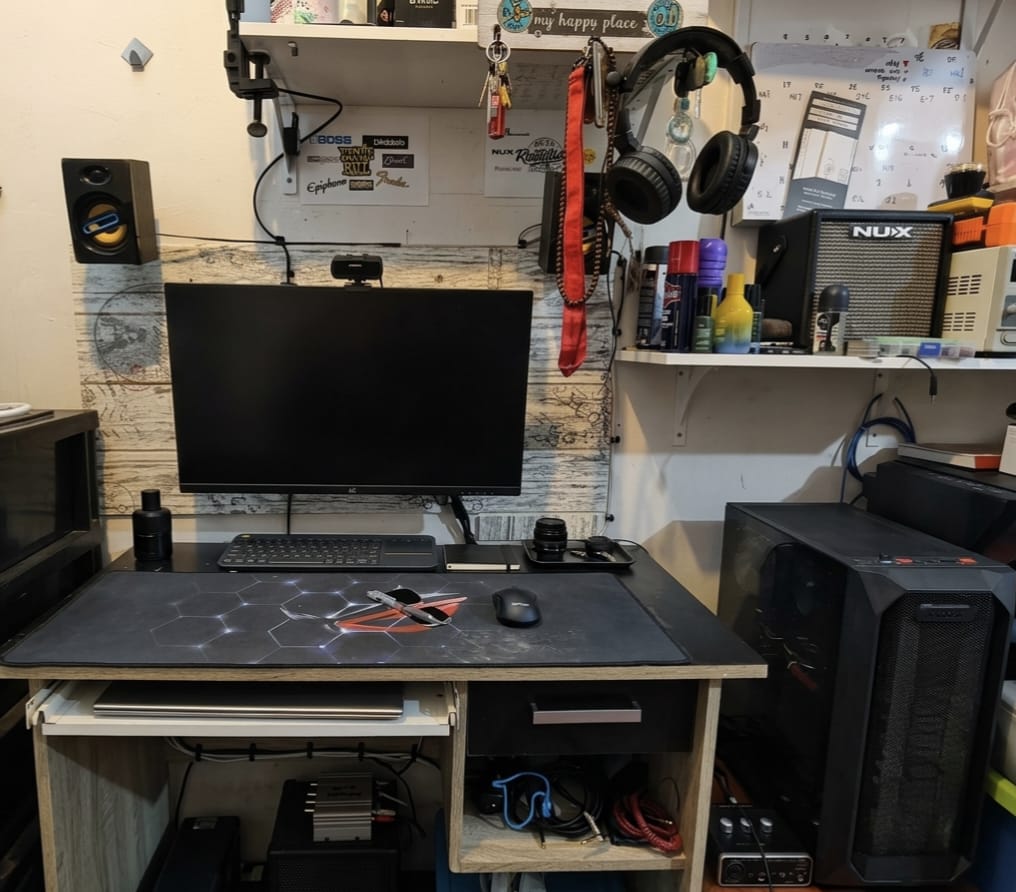
One room. Two purposes. Better zoning.
The trick is not to divide the room into two completely separate spaces. Instead, create clear zones that can share equipment, power, storage and desk space.
Start With Zoning
When one room needs to serve several purposes, the first thing to decide is where each activity naturally belongs.
Your computer desk can remain the centre of the workspace while the music area occupies the surrounding space. The important thing is to avoid allowing every piece of equipment to spread across every available surface.
When you know where work happens and where music happens, it becomes much easier to keep the room organised.
Build a Focused Work Zone
The work area should contain only the equipment that you use regularly for work or study.
A monitor, keyboard, mouse and essential accessories are usually enough. Anything that does not need to stay on the desk can move to a shelf, drawer or another storage area.
Create a Practical Music Corner
A music corner does not need to look like a professional recording studio. A guitar, amplifier, small audio interface and a few accessories can already create a useful creative space.
The most important thing is accessibility. If the guitar is hidden behind boxes or buried inside a case, you are less likely to pick it up and play.
Make your instrument easy to reach.
A small music corner works best when the instrument is visible and accessible without interfering with your daily workspace.
Connect Everything Without Creating Chaos
This is where a combined office and music setup can become messy very quickly. Computer cables, power cables, USB connections, audio cables and guitar cables can all end up crossing the same area.
Instead of hiding everything randomly, create simple cable routes. Keep power cables together where possible and separate audio signal cables from unnecessary clutter.
A cable that is neatly routed and easy to trace is much better than one that is hidden so deeply that you cannot figure out where it goes later.
Let the Two Zones Share Equipment
One of the biggest advantages of combining an office and music corner is that some equipment can serve both purposes.
A good pair of headphones, powered speakers, monitor, computer and audio interface can all become part of a shared setup rather than requiring separate equipment for each activity.
The best equipment earns its space.
In a small room, every device should ideally have more than one useful role. This keeps the setup compact and makes the room easier to manage.
Does Your Combined Setup Work?
Your room does not need to be perfect.
A real home workspace will probably never look like a showroom — and that is completely fine. What matters is whether the room works for the way you actually live, work and create.